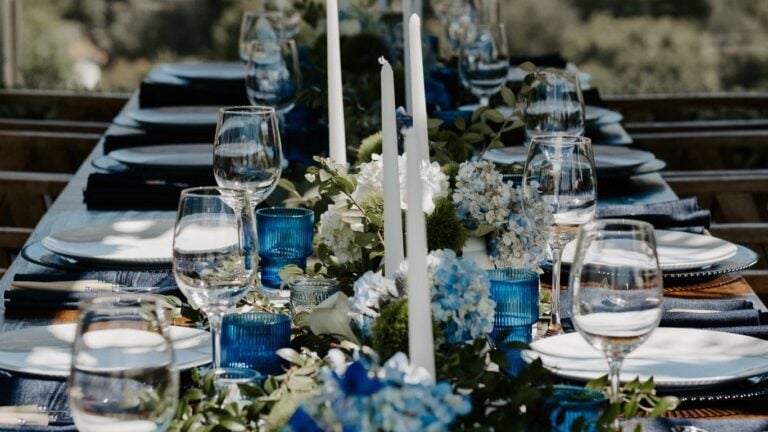
How do you design an eco-friendly floral event in Los Angeles?

We get asked about sustainability more than almost any other topic right now. Clients planning galas in Malibu, corporate activations in Beverly Hills, and private parties in the Hollywood Hills all want the same thing: extraordinary florals that don’t leave a pile of single-use plastic, imported out-of-season blooms, and landfill waste behind. That’s a completely reasonable thing to ask for, and it’s where we’ve been heading as a studio for years.
What follows is a practical account of how we approach eco-friendly floral design for events across Southern California. Not theory. Not vague commitments. The actual choices we make, the mechanics we use, and the decisions that genuinely make a difference.
Why does foam-free design matter so much?
Floral foam is the thing most people haven’t thought about. It’s the green block that holds arrangements in place, and it’s a single-use petroleum-based plastic that never breaks down. Every conventional arrangement built on foam contributes to microplastic pollution in soil and waterways, and there is no recycling stream for it anywhere in the country.
Switching to foam-free mechanics is the single most impactful change a florist can make. We use chicken wire, reusable pin frogs, water tubes, natural moss, and structure made from branches and twine. The results look different from foam work, in the best way. Arrangements have more movement, more air, and more natural character. Our custom floral installations across LA have been foam-free for years, and we’ve never had a client ask us to go back.
For large installations like arches and walls, we design the armature from reusable metal frameworks and natural materials. Once the event ends, the mechanics come back to our studio and get used again. The flowers compost. Nothing goes to landfill by design.
How do locally sourced California flowers change the design?
Southern California is one of the most productive cut-flower growing regions in the country. The Carlsbad Flower Fields, the farms along the coast between San Diego and Santa Barbara, and the cooperative growers in the Central Valley produce exceptional blooms. When we source locally, the flowers arrive the same day or the day after cutting. That freshness shows in every petal, and it means fewer airmiles than the Colombia, Ecuador, and Kenya route that much of the industry still relies on.
For our Los Angeles floral arrangements, we work with a small group of California farms who grow for studio florists rather than the mass market. That means we can request specific varieties and colors rather than taking whatever the wholesale floor offers.

What does designing with seasonal flowers actually look like?
Seasonal design is not a constraint. It’s a creative brief.
In January, the palette includes ranunculus, anemones, sweet peas, hellebores, and narcissus. Come May, it’s peonies, garden roses, and the first dahlias of summer. By October, chrysanthemums, cosmos, and richest burgundy dahlias. Each season has its own personality, and designing within that produces work rooted in a particular moment rather than generic.
The alternative, forcing an out-of-season bloom because a client saw it on Pinterest in December, means flowers treated with more chemicals, higher costs, and shorter vase life. We steer clients away from that approach because the seasonal option almost always performs better. For large events, we present the seasonal palette three to four months ahead so clients plan their color story with what will actually be at its best on the day.
How do dried and preserved botanicals fit into eco-friendly event design?
Dried and preserved botanicals have had a significant moment in event design. A preserved eucalyptus garland can serve a dozen events before it composts. Dried pampas grass and bunny tails can be designed into a ceremony arch that travels from a Beverly Hills hotel to a warehouse venue in Arts District without losing character.
We use dried and preserved elements in three situations: where longevity matters across a multi-day conference on Wilshire Boulevard; where the texture brief calls for the warmth that dried botanicals add to earthy, warm-toned palettes; and where the client wants to keep something after the event ends. A dried bouquet or a preserved wreath can live in a home long after the reception closes.
The key is sourcing preserved botanicals processed with glycerin or air-drying rather than synthetic chemicals. We vet suppliers on this and can tell clients exactly how each element was prepared. For flower wall rental and longer-running installations, dried and silk hybrid designs give the most reliable results.

Is renting floral installations more sustainable than buying single-use designs?
For certain event types, yes. Decisively.
A flower wall rental means one installation gets used dozens of times. The materials, the framework, the labor of building it all get amortized across many events rather than landing on a single brief. For corporate events, product launches, and pop-up activations where the floral piece is primarily a backdrop rather than a bespoke design statement, a rental makes both financial and environmental sense.
Our rental collection includes designs we’ve refined over years of events across Los Angeles, Orange County, and beyond. The flower and green wall rental service covers everything from a lush crawling ivy wall to full fresh-bloom builds. Each rental comes with delivery, installation, and collection at the end of the night, with no waste left at the venue.
Where rental doesn’t work is when the brief requires something genuinely specific to that event. A centerpiece suite designed around a client’s exact color story, a branded installation built around a logo, or a custom Beverly Hills event installation that needs to fit the architecture of one particular venue. Those should be custom builds. But a lot of events that default to single-use custom work don’t actually need that level of bespoke, and for those clients, rental is the right call.
What happens to the flowers after the event?
This is the question that separates serious sustainable practice from surface-level greenwashing, and it’s one we’ve thought hard about.
For large events, we coordinate donations to local hospices, care homes, and community organizations across LA. Fresh flowers that would otherwise compost on Monday arrive at a care home in the San Fernando Valley or a hospice in Long Beach by 9am. Several couples have told us this became one of their favorite parts of the day.
For corporate events, many of our fresh flower bar setups include a take-home element: guests receive small arrangements or single stems as a parting gift, which means a large proportion of the fresh material leaves with people rather than going to waste. For larger installations, botanical materials go to a composting facility serving farms and gardens in the LA area. Nothing we build is designed to go straight to landfill.
How do compostable mechanics change what’s possible in a design?
Moving away from foam doesn’t mean moving toward less interesting structures. Quite the opposite.
Natural binding materials, woven branches, moss-lined vessels, and reusable ceramic containers produce different visual results from foam-supported work. A centerpiece on a pin frog inside a low ceramic bowl has a sculptural quality that foam can’t create. A hanging installation built from twine-wrapped branches feels alive in a way a plastic grid frame doesn’t.
We use compostable mechanics as a design starting point. Moss bases, ceramic vessels, and branch curves become part of the finished piece. For events at Greystone Mansion or private estates in Pacific Palisades, that handcrafted quality is exactly what the space demands. We design directly into natural wood rounds, slate bases, or repurposed vessels from makers in Arts District and Silver Lake. Our approach to personalizing events through custom florals leans on this kind of material thinking.
Which LA neighborhoods and venues lead on sustainable event design?
Malibu, Pacific Palisades, and the beachside communities tend to be most explicit about sustainability requirements. Their clients feel the connection between what happens at an event and what washes up on the beach. Silverlake and Echo Park bring strong botanical and naturalistic briefs. The Beverly Hills and Bel Air private event market has shifted noticeably toward seasonal and locally sourced design over the past few years.
Several outdoor estates in the Santa Monica Mountains, Topanga Canyon, and Malibu wine country have made foam-free and composting mandatory for all vendors. We were already working that way. For events in Malibu or Santa Monica, we know what those venues require from day one. The benefits of renting floral installations for temporary events are particularly relevant here, where maximum visual impact with minimal material waste is exactly the brief.

What should clients ask their florist to confirm sustainable practice?
Not every studio that claims to be sustainable is working the same way. These are the questions worth asking before you book: Do you use floral foam, and if so why? Do you source from California growers, and which farms specifically? What happens to the florals after the event ends? What compostable or reusable mechanics do you use? Can you design the full brief within the seasonal palette for the event date?
A studio genuinely working this way will have immediate, specific answers to all of them. For a complete picture of what seasonal flower design looks like across the calendar, see our guide to working with fresh flowers across the year.
How does sustainable design connect to the look of floral installations?
The most common concern clients raise is that sustainable equals restrained. In our experience, the opposite is true. The most photographed installations we’ve built have all been foam-free, seasonally driven work. A fresh wildflower wall built on natural wire and moss mechanics. A crawling ivy and eucalyptus wall that photographed like a forest glade and composted cleanly the following morning. A ceiling installation for a corporate dinner in Downtown LA, built from dried botanicals and seasonal branches, that guests were still photographing two hours in.
Sustainable design tends to look alive. It has texture, imperfection, and depth that comes from working with materials honestly. That’s what our custom flower installation work has been built on.
If you’re planning a private event, a corporate activation, or a brand launch in Los Angeles, Beverly Hills, Malibu, Santa Monica, or anywhere across Southern California, and you want florals that are genuinely thoughtful about where they come from and where they go after, get in touch with the studio. We’ll talk through the brief, walk you through the seasonal options for your date, and show you exactly what eco-friendly event florals look like at the level our clients expect.
Frequently asked questions
Does foam-free floral design cost more than conventional floral work?
Not in our experience. The mechanics we use instead of foam, such as pin frogs, chicken wire, water tubes, and natural binding materials, cost similar amounts and often last longer because they’re reusable. The design process is slightly different, but the final price to the client is comparable to conventional work of the same scale and complexity.
Can I request specific California farms for my event florals?
Yes. We work with a small group of California growers directly and can prioritize their stock when availability aligns with your brief and event date. The best results come from planning three to four months ahead so we can place advance orders with farms rather than sourcing from the wholesale market at the last minute.
What flowers are in season for a late summer event in Los Angeles?
Late summer in Southern California is peak season for dahlias, zinnias, cosmos, sunflowers, and garden roses. Lisianthus and stock also perform well in August and September. Locally grown versions of these varieties are widely available from farms in Ventura, San Diego, and the Central Valley, and they arrive with exceptional stem strength and vase life.
Do you coordinate flower donations to charities after events?
Yes. We connect clients with local hospices, care homes, and community organizations across the LA region who receive donated arrangements the morning after the event. We handle the coordination with the receiving organization so there’s nothing the client or their planner needs to manage on the day. This is included as part of our service for events where the client wants it.
What is the difference between preserved and dried botanicals?
Dried botanicals are air-dried or dehydrated, which removes moisture and stops decay. Preserved botanicals have been treated with glycerin or similar plant-based solutions to maintain their flexibility and color while preventing decay. Both are suitable for event design. We use glycerin-preserved eucalyptus, ferns, and palm fronds alongside air-dried pampas, bunny tails, and seed pods, and we can explain exactly how each element in your brief has been prepared.
Can an eco-friendly floral brief still look luxurious for a high-end event?
Completely. Some of the most spectacular work we’ve produced for Beverly Hills galas, celebrity parties, and high-profile brand activations has been entirely foam-free, locally sourced, and seasonal. Sustainable practice and luxury florals are not in conflict. The craft, the design thinking, and the quality of materials are what determine the result, not whether the arrangement was built on plastic foam or a pin frog.