What makes a flower wall visually beautiful? A design principles guide

We think about flower wall aesthetics constantly. Every design decision we make in our LA studio, from the ratio of blush roses to ivory ranunculus on the Blush Pink Rose wall to the exact projection depth of a custom fresh installation, is a choice with a visual consequence. If you’re new to the format, our main flower walls guide covers the basics of what a flower wall is and how it works. This piece focuses on something different: the design principles that determine whether a wall is merely large or genuinely beautiful.
These principles hold regardless of event type, venue, or flower species. They’re about light, color, depth, proportion, and the relationships between materials. Once you understand them, you’ll look at any flower wall differently.

Why does color hierarchy matter more than color count?
The most common mistake in flower wall color design is treating the palette as a list of colors rather than a composition with weight and direction. A wall with five colors can look chaotic. A wall with five colors and a clear lead tone taking up roughly 60 percent of the surface reads as intentional and refined.
We structure most custom walls around a three-tier hierarchy. One dominant color sets the mood. One supporting color adds dimension. One accent draws the eye to specific areas without competing overall. Greenery sits outside this hierarchy, acting as the negative space that lets the composition breathe.
When a wall feels “too busy,” the problem is almost always that no color has enough weight. Every tone is fighting for equal attention. Our Pink Ombre wall shows hierarchy working in a different way: the gradient from deep rose at the base to pale blush at the crown gives the eye a path to follow rather than a static surface to scan.
How does depth and dimensionality change what a wall looks like?
A flower wall built on a flat plane, where every bloom sits at the same distance from the backing structure, reads like a large photograph of flowers rather than flowers themselves. Real depth is what separates a wall that looks like a prop from one that looks like a living design object.
We build our walls with intentional surface variation. Some blooms are pressed tight to the backing. Others project forward by two or three inches. Larger statement blooms sit at the surface while smaller filler flowers and foliage recede. This creates the shadow play that makes a wall look genuinely lush, even in still photography. When directional light hits a surface with genuine depth variation, you see individual blooms and shadows between petals. That’s what guests photograph, not the wall as a concept but the texture of light moving across it.
What role does lighting play in how a flower wall looks?
Lighting is a design variable that most clients don’t think about until it’s too late. The color and warmth of the venue’s light source changes the visual color of the flowers on the wall, sometimes significantly.
Warm tungsten or candlelight pulls pink tones warmer and pushes ivory flowers toward cream or yellow. Cool LED uplighting does the opposite, pushing blush toward lavender and ivory toward stark white. A Blush Pink Rose wall that looks precisely right in a candlelit Beverly Hills ballroom can look desaturated under a venue’s cool white fluorescents.
When we design a custom wall for a specific venue, we ask for the lighting spec or visit the space before the design is finalized. The White Wonderland wall, for instance, responds beautifully to warm wash lighting, taking on a golden quality that reads as opulent. Under cool light, that same wall reads as clinical. Knowing the light before fixing the palette is part of how we avoid that outcome.
How does material mix affect the visual texture of a flower wall?
Some of the most visually arresting walls we’ve built contain three or four different material types, and that variety is the reason they photograph so well. A surface made entirely of identical roses has a kind of uniformity that the eye registers and then stops engaging with. A surface that mixes fresh open roses, tighter rosebuds, loose peonies, clusters of ranunculus, and trails of eucalyptus gives the eye something to keep discovering.
Material mix also changes how light behaves across the surface. Matte petals absorb light and read as soft. Glossy tropical leaves and waxy gardenias catch light and create bright points. Dried elements like pampas grass add structural lines that contrast with the organic roundness of fresh flowers. Our Real Pampas wall uses exactly this contrast: feathery dried pampas against the density of silk roses creates a surface that reads as both delicate and sculptural.
Fresh and silk hybrid designs are worth considering for their optical qualities. Premium silk blooms have a consistency in petal shape and color that fresh flowers don’t, giving the wall a graphic quality that suits some aesthetics better than the slight irregularity of fresh blooms. Neither is better. The choice should be made on the basis of the visual outcome you want.

What is a focal point in a flower wall design, and why does it matter?
A focal point is the part of the wall that the eye naturally moves toward first. In architectural design, every well-composed surface has one, and flower walls are no different. Without a focal point, the eye wanders across the surface without settling, which creates a visual restlessness that the viewer senses even if they can’t identify it.
Focal points can be created several ways. A cluster of statement blooms in a contrasting color draws attention to a specific area. A gradient that flows from dark to light creates an implied direction. Signage, monograms, or neon elements placed in the upper center anchor the whole composition. The Secret Garden wall uses dense floral clusters at the center with looser greenery at the edges, drawing the eye to the middle without making the border feel empty.
Where the focal point sits matters too. For a photo backdrop, it should be at head height when standing so it sits in the frame with the subject. For a purely decorative installation viewed from distance, the focal point can sit higher and lend the wall a sense of scale.
How does proportion affect whether a flower wall looks impressive or awkward?
Proportion is the relationship between the wall’s dimensions and the space it occupies. A wall can be beautifully designed in isolation and still look wrong in a room because the proportions are off relative to the ceiling height, the width of the surrounding wall, or the floor space in front of it.
The most common mistake is a wall that’s too narrow for the room. A wall that’s eight feet wide in a ballroom with forty feet of wall space looks like a small object placed in a large space rather than a design decision. Width should scale to viewing distance: the further guests stand from the wall, the wider it needs to be to read as substantial. Height matters equally. Most standard frames are eight feet tall, which suits a venue with a ten-to-twelve-foot ceiling well. In a room with twenty-foot ceilings, that same frame looks squat. The Crawling Ivy and Eucalyptus wall works well in high-ceilinged spaces because the trailing foliage softens the top edge and gives the wall a sense of upward growth rather than a hard rectangular border.
Why does the relationship between flowers and foliage define the overall aesthetic?
Foliage is often treated as filler, the greenery added between flowers to cover gaps. In well-designed walls, foliage is a structural element as deliberate as the flowers themselves. The proportion of foliage to bloom determines whether a wall reads as lush and botanical or dense and floral. Both are valid aesthetics, but they suit different design contexts.
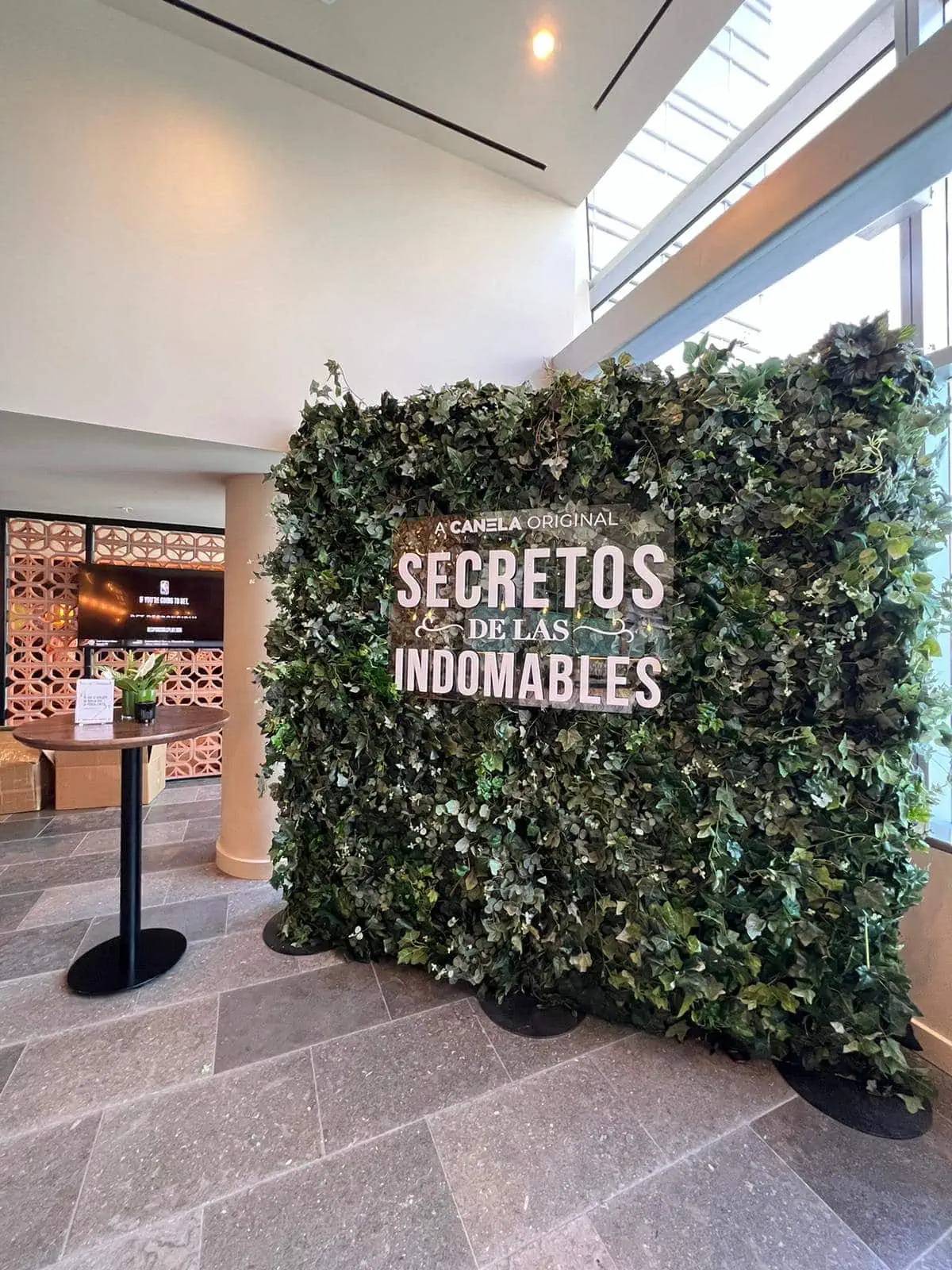
A foliage-forward design uses greenery as the primary surface material with blooms placed as accents. The result is architectural and graphic. Our Tropical Green wall takes this approach: large tropical leaves create a backdrop of deep green against which any accent bloom pops dramatically. This reads as modern and structural, suited to clean contemporary venues and brand activations.
A bloom-forward design uses greenery sparingly, enough to provide breathing room and color contrast, but placing flowers as the dominant visual material. The effect is lush and rich. This tends to be the preference for luxury wedding ceremony walls and private residential events where the goal is warmth and abundance. See our full flower wall rental collection for examples of both approaches.
How does scale within a design (large blooms vs. small blooms) create visual interest?
Varying bloom scale from large statement flowers to small filler clusters creates the visual complexity that holds a viewer’s attention. A surface built entirely from flowers of the same size can feel static, even when the color is beautiful. Mixing large-scale peonies or dahlias with small ranunculus, berry clusters, or tightly-packed rosebuds creates a rhythm that moves the eye across the surface.
The principle mirrors typography: contrast in scale creates hierarchy, and hierarchy creates visual interest. Large blooms are the headlines of the composition. Small filler flowers and foliage are the texture between them. When all three scales are present in considered proportions, the wall has a richness that single-scale designs don’t achieve. Our Color Burst wall mixes bloom scale across a bold multi-color palette, and that combination is what makes it photographically active.
To see how we apply these principles in practice, visit our custom floral installations page. Our post on incorporating seasons into your flower wall design looks at how these principles shift across the LA calendar year, and our piece on flower walls for weddings covers how they apply to the wedding context specifically.
If you’re planning an event in Los Angeles, Beverly Hills, Santa Monica, West Hollywood, Malibu, Calabasas, Pasadena, or across Southern California, and you want to talk through the aesthetics of a flower wall for your space, our design team would love to sketch something out with you. Get in touch with the studio and we’ll start with the visual brief.
Frequently asked questions
What is the most important visual principle in flower wall design?
Color hierarchy is the single most important factor. A wall with a clear dominant color, one supporting tone, and a controlled accent color reads as intentional and elegant. A wall where every color competes for equal attention looks busy regardless of how beautiful the individual flowers are. Getting the color weight right before selecting specific blooms is where good flower wall design actually starts.
Why do some flower walls look flat in photographs?
Flat-looking walls are almost always built on a single depth plane, where every bloom sits at the same distance from the backing structure. Depth variation allows light to create shadows between flowers and makes the surface look three-dimensional even in still photography. It’s one of the most important but least visible decisions in how we build walls.
Do fresh flowers and silk flowers look different on a wall?
Yes, and the difference is most visible up close. Fresh blooms have slight natural irregularities in petal shape and a softness that silk can’t fully replicate at close range. Silk walls have a consistency that makes them more graphic in photographs and better suited to venues with less than ideal light. The decision should be based on viewing distance, lighting conditions, and the visual quality you’re aiming for.
How do you choose the right bloom-to-foliage ratio for a flower wall?
A high bloom-to-foliage ratio reads as lush and opulent, ideal for luxury weddings and private events. A foliage-forward ratio reads as architectural and contemporary, better suited to corporate activations and brand events. For most events, we aim for enough greenery to let the flower clusters breathe rather than filling every inch with blooms.
How important is bloom scale variety in a well-designed flower wall?
Very important. A wall built entirely from flowers of the same size looks flat and uniform even when the color is beautiful. Mixing large statement blooms with smaller filler flowers creates visual hierarchy and gives the eye something to discover across the surface. Think of it as the difference between a page set in one font size and one with clear typographic hierarchy. One directs the eye. The other makes everything equally easy to ignore.
Can the design principles in this guide be applied to a rental flower wall, or only custom builds?
They apply to both. When selecting a rental wall, you can use these principles to evaluate what you’re looking at. Does the wall have clear color hierarchy? Is there visible depth and texture variation? Does the bloom-to-foliage ratio suit your venue’s aesthetic? Our flower wall rental collection is designed with these principles built in, which is why each wall in the range has a consistent visual identity rather than a generic “flowers on a frame” quality. Browse the collection and filter by the aesthetic principles that matter most for your event.